This guide provides a comprehensive overview of multi unit freehold block (MUFB) mortgages in the UK. It is designed for landlords, property investors, and developers seeking to understand MUFB finance, lending criteria, and the role of specialist mortgage brokers. Learn why MUFBs matter, how they differ from other property types, and how to secure the best mortgage for your investment.
Key Points: MUFB Mortgages Summary
- Definition: A multi unit freehold block (MUFB) is a single property held under one freehold title containing multiple self-contained units (flats or houses), each with its own kitchen, bathroom, and tenancy agreement.
- Difference from HMOs: MUFB residents have entire units to themselves, whereas HMO tenants share common facilities.
- Loan-to-Value (LTV): Typical LTV offered by lenders is up to 75%, requiring a 25% deposit.
- Eligibility: Borrowers can be individuals, limited companies (SPVs), trusts, or pension schemes, with lenders usually preferring applicants who have prior experience in complex property investments.
- Rental Income Requirements: Rental income must generally cover 125-145% of monthly mortgage payments to meet lender affordability criteria.
- Number of Units: MUFB mortgages typically cover 2 to 10 or more units on a single freehold title.
- Valuation Methods: Lenders use either investment valuation based on rental yields or aggregate valuation, summing values of individual units.
- Costs and Rates: MUFB mortgage rates tend to be higher than standard buy-to-let mortgages due to perceived risks, with deposit requirements often higher for complex cases.
📞 Call for immediate expert advice. 💻 Complete our enquiry form 📧 Email outline your requirements
Fast answers: MUFB mortgages & MUFB mortgage brokers (UK)
A multi unit freehold block—commonly known as an MUFB—is a single property held under one freehold title that contains multiple self-contained residential units, each with its own kitchen, bathroom, and separate tenancy agreement. MUFBs can include properties with multiple flats or multiple houses under one freehold title. MUFB mortgages are specialist finance products designed to fund the purchase, refinance, or development exit of these multi-unit properties.
This guide is intended for UK landlords, property investors, and developers seeking multi unit freehold block mortgage brokers and aiming to secure MUFB mortgages from £250,000 upwards. Multi unit mortgages are specialist products tailored for these types of properties. Fox Davidson Ltd, based in Bristol and advising clients UK-wide, specialises in complex buy-to-let, MUFB, HMO, and commercial mortgages.
This article covers:
- The definition of multi unit freehold blocks and their distinction from HMOs and standard buy-to-let properties
- The operational details of MUFB mortgages, including typical loan structures, LTVs, and rental coverage requirements
- Current indicative MUFB mortgage rates, deposit expectations, and associated costs for 2024–2025
- Lending criteria applied by MUFB mortgage lenders and borrower eligibility
- The benefits of working with a specialist mortgage broker to streamline your application and access better MUFB mortgage deals
Our focus is on properties in England and Wales, with typical loan sizes ranging from £250,000 to £25 million and beyond. Initial consultations with Fox Davidson are free and without obligation.
Investors should be aware that financing MUFBs can be challenging due to their specialised nature, and fewer lenders support MUFB mortgages, often requiring prior landlord experience.
What is a Multi Unit Freehold Block (MUFB)?
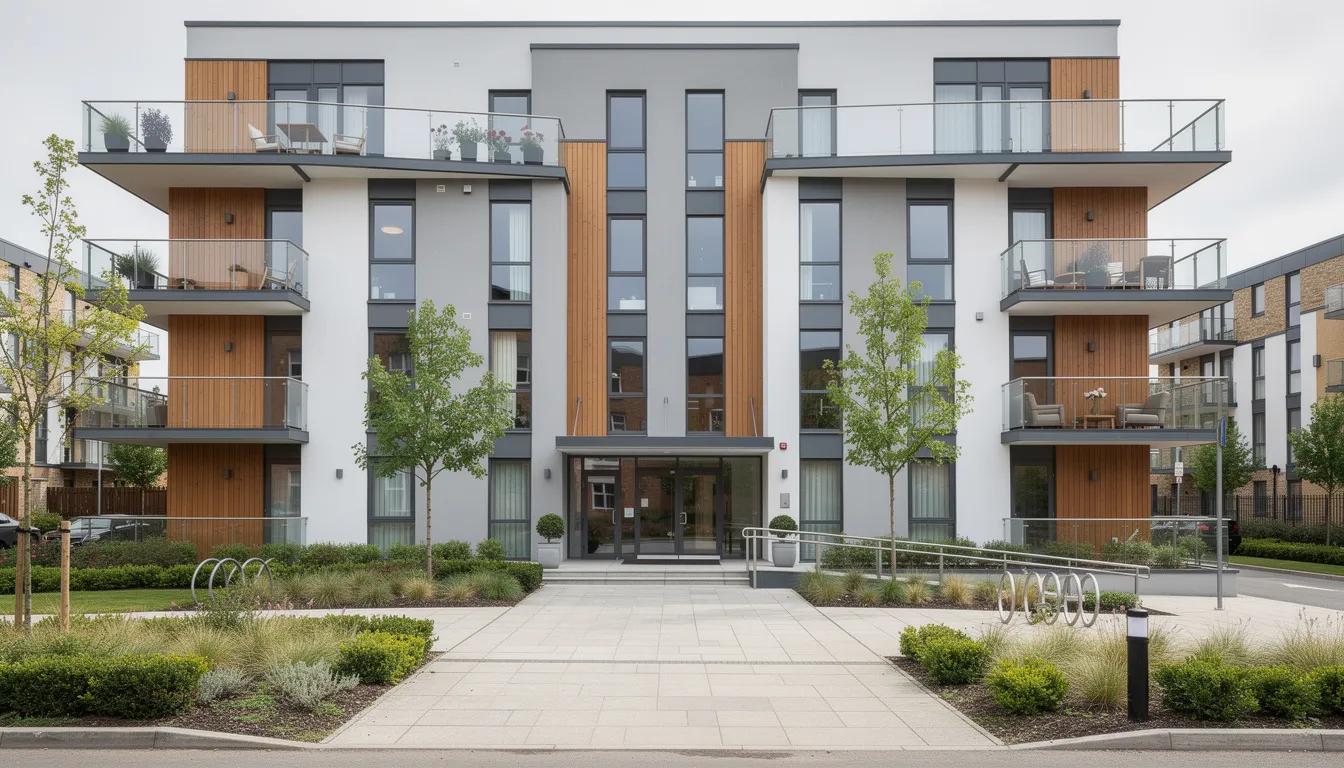
A multi unit freehold block is a property where multiple self-contained units—typically flats or houses—are held under a single freehold title registered at HM Land Registry. Each unit operates independently with its own kitchen, bathroom, living space, and usually its own assured shorthold tenancy agreement with individual tenants. This property structure offers flexibility and benefits for investors by consolidating multiple units under one legal ownership.
Definition of Freehold and Leasehold:
An MUFB is held under a single freehold title, unlike properties with multiple leaseholds. Freehold ownership means you own the building and the land it stands on outright, while leasehold ownership provides rights to the property for a set period but not the land.
Common examples of MUFB properties include:
- A Victorian house in Bristol converted into 3–4 self-contained flats
- A 12-unit purpose-built block of apartments in Manchester city centre
- A terrace of 5 houses held on one freehold title in Leeds
- A converted Georgian townhouse split into 6 individual flats in London
All units share one freehold title number rather than separate leaseholds, though the owner can create long leases later if intending to sell individual units. This structure provides perpetual ownership of both the building and the land beneath it.
The number of units influences the mortgage products available. Smaller MUFBs with 2–6 units typically qualify for specialist buy-to-let mortgages, while blocks with 7–20+ units often require commercial or semi-commercial mortgage terms with different pricing and criteria.
Tenancies are usually assured shorthold tenancy agreements (ASTs) of 6–12 months, although some specialist lenders accept corporate lets, serviced accommodation, or student lets subject to their own criteria. MUFB properties may be purpose-built blocks (e.g., constructed post-2010 with an NHBC warranty) or converted buildings (such as a pre-1919 house converted in 2015 with planning and building regulations approval).
The property’s location is a critical factor in determining rental demand and investment viability.

Understanding commercial property and where MUFBs fit
Commercial property in the UK encompasses a wide range of investment opportunities, including office buildings, retail units, industrial warehouses, and multi-unit residential assets. Multi unit freehold blocks (MUFBs) occupy a unique position within this spectrum. Although MUFBs are residential in use, their structure—multiple self-contained units under a single freehold title—often results in them being classified as commercial property for lending and investment purposes.
For property investors, MUFBs offer the advantage of generating multiple rental income streams from one freehold title, which can lead to higher rental yields compared to single-unit investments. This diversification within a single asset helps mitigate the impact of void periods, as income from occupied units can offset temporary vacancies. MUFB mortgage lenders recognise these benefits and have developed specialist products tailored to the unique characteristics of multi unit properties.
Building a property portfolio with MUFBs enables investors to scale efficiently, manage risk, and potentially unlock greater capital growth. The commercial property classification also provides access to a broader range of finance options, including those designed specifically for unit freehold blocks. Whether acquiring a purpose-built block or a converted building with multiple self-contained units, understanding MUFBs’ place within the commercial property market is essential for maximising investment strategy and achieving higher rental yields.
MUFB vs HMO – key differences for mortgages
Multi unit freehold blocks (MUFBs) and houses in multiple occupation (HMOs) both involve multiple tenants, but their structure, regulation, and mortgage treatment differ significantly. These differences influence lender panels and mortgage terms.
The primary distinction is that MUFB residents have entire self-contained units, each with its own kitchen and bathroom, while HMO tenants share common facilities such as kitchens and bathrooms.
MUFB features:
- Self-contained units with individual kitchens and bathrooms
- Separate assured shorthold tenancy agreements for each flat
- Usually no HMO licence required, subject to local authority rules
- Valued on investment yield or aggregate break-up basis
- Broader lender appetite due to lower perceived risks
HMO property features:
- Individual bedrooms with shared kitchen and bathroom facilities
- Single tenancy agreement or multiple room-by-room agreements
- Mandatory licensing under the Housing Act when 5+ occupiers from 2+ households share facilities
- More intensive property management requirements
- More limited lender panel and typically higher interest rates
Some specialist lenders offer a single “specialist buy-to-let” product range covering both HMOs and MUFBs, but pricing, maximum units or bedrooms, and stress testing differ between the two.
For property investors, MUFBs are generally easier to sell, refinance, or exit to another investor. HMOs can deliver higher gross yields but involve a narrower mortgage market and heavier regulatory burden.
Feature | MUFB | HMO |
|---|---|---|
Unit type | Self-contained flats | Bedrooms with shared facilities |
Facilities | Own kitchen/bathroom per unit | Shared kitchen/bathroom |
Licensing | Usually not required | Often mandatory (5+ occupiers) |
Lender appetite | Broader specialist panel | Narrower specialist panel |
Typical LTV | Up to 75–80% | Up to 70–75% |
Management intensity | Moderate | Higher |
Why investors choose MUFBs – pros and cons
Multi unit freehold blocks occupy a middle ground between standard single-let buy-to-let properties and large-scale developments. They offer portfolio landlords a way to build scale and diversify rental income within a single asset.
Advantages of MUFB investment:
- Multiple rents from one property reduce the impact of void periods; if one unit is empty, others continue generating income
- Economies of scale on maintenance, insurance, and block management costs
- Potential for higher rental yields than equivalent single lets in the same location
- Ability to refinance using aggregate valuations, potentially unlocking more equity
- Future option to create long leasehold titles and sell individual flats to realise capital gains
- Easier to manage via a single block manager or property management company rather than multiple scattered properties
- Attractive to professional tenants, students, or young professionals depending on location
- Compatible with limited company SPV structures for tax planning (investors should seek specialist tax advice)
Disadvantages and challenges:
- More complex to finance than standard buy-to-let, with a smaller lender panel and slightly higher rates and fees
- Higher entry price requiring larger deposits, often 25%–35% of property value
- Management complexity when units are in different conditions or tenancy stages
- Potential planning or building control issues on older conversions without proper sign-off
- Fire safety requirements including EWS1 certificates for certain blocks built post-2000 with cladding
- Concentration risk: all rental income depends on demand in one micro-location
Rising costs and tougher legislation have made it more difficult for landlords to operate in recent years, affecting MUFB investments.
How MUFB mortgages work
MUFB mortgages are generally classified as buy-to-let or commercial investment loans. Unlike residential mortgages assessed primarily on personal income, these products are underwritten predominantly on the rental income the property generates. The underwriting process is more complex because it involves assessing income from multiple tenants and evaluating tenant risk.
Interest Only vs Capital Repayment
Most MUFB mortgages are structured as interest only over terms of 5–30 years, though capital repayment options exist for investors who prefer to build equity. The most common products in the 2024–2025 mortgage market are 2-year and 5-year fixed rates, offering payment certainty during the initial period. The mortgage interest rate directly influences monthly payments and overall loan affordability, whether fixed, variable, or tracker.
Loan-to-Value (LTV) Limits
- Specialist lenders typically offer up to 75% LTV for well-located, standard construction MUFBs
- Some commercial lenders offer 80–85% LTV with stronger covenants, lower yields, or additional security
- Loans generally start around £250,000, with larger commercial facilities extending into tens of millions for substantial blocks or property portfolios
Rental Coverage Requirements
Lenders stress-test rental coverage at 125%–145% of the mortgage payment, calculated at a notional rate (often 5%–8%) depending on product type, fixed vs variable rates, and borrower type (limited company or individual). This ensures rental income can cover mortgage repayments, a key factor in mortgage approval and affordability.
Example:
A 10-unit MUFB valued at £1.2 million generates £7,500 pcm in gross rent. At 75% LTV, the maximum loan is £900,000. The lender stress-tests at 145% coverage using a 5.5% notional rate. Monthly interest on £900,000 at 5.5% is approximately £4,125. Required rental coverage at 145% is £5,981 pcm, comfortably met by the £7,500 actual rent.
Types of MUFB mortgages & finance options
Understanding the different finance options available for MUFBs is essential for investors. Product choice depends on whether you are purchasing, refinancing, converting, or exiting development finance. Each scenario has distinct lender considerations.
Standard MUFB buy-to-let mortgages
- Commonly available with 2-year and 5-year fixed rates
- Discounted variable and tracker products also offered
- Suitable for personal name or limited company borrowers
- Typically up to 75% LTV on standard blocks
- Different from standard residential mortgages due to rental income assessment and lending criteria
Interest Only vs Capital Repayment
- Interest only lowers monthly repayments and maximises cash flow
- Favoured by portfolio landlords for tax efficiency (subject to professional advice)
- Capital repayment builds equity but reduces distributable income
Bridging Loans for MUFBs
- Short-term finance (6–18 months)
- Used for auction purchases requiring fast completion
- Ideal for heavy refurbishment or creating new units under permitted development rights
- Exit route from expensive development finance while stabilising lettings
Development Finance
- For ground-up blocks or major conversions
- Staged drawdowns aligned to build milestones
- Exit via term MUFB mortgage once fully let and approved by building control
Remortgage and Capital Raising
- Second-charge or full remortgage on existing blocks
- Release equity for further acquisitions or portfolio restructuring
- Often used when property value has increased post-refurbishment
Specialist lenders often provide more flexible terms for MUFB mortgages compared to conventional banks.
Lending criteria for MUFB mortgages (who can borrow?)
MUFB lending criteria are more specialised than standard buy-to-let but remain accessible to experienced landlords and, in some cases, well-prepared first-time MUFB investors.
Borrower types accepted
- Individuals (personal name ownership)
- SPV limited companies (common for acquisitions)
- Trading companies and LLPs
- Some trusts and pension schemes (SSAS/SIPP) via specialist routes
- UK-resident directors and shareholders preferred; some lenders accept expatriates and foreign nationals
Experience requirements
- Many MUFB mortgage lenders prefer 12–24 months’ landlord experience
- A small existing buy-to-let or HMO portfolio strengthens applications
- Some lenders consider first-time landlords if income, assets, and management plans are strong
- Having a professional property management company can offset limited experience
Age requirements
- Common minimum age is 21
- Some lenders apply upper age limits at application (e.g., 75) or term end (e.g., 85)
- Others have no upper age limits if the exit strategy is credible
Property location
- Primarily England and Wales
- Large Scottish blocks and properties in Northern Ireland may require different lenders or legal frameworks; bespoke advice is essential
Tenancy and rental requirements
- Assured shorthold tenancy agreements usually required
- Corporate lets, student accommodation, and serviced accommodation accepted by some specialist lenders
- Adjusted stress tests and yield assumptions apply for non-standard tenancy types
Adverse credit, complex income structures, or offshore ownership require specialist mortgage brokers to place with the right lender.
MUFB mortgage lenders are typically specialists rather than mainstream banks or building societies. Mainstream lenders often avoid MUFBs due to their complexity, so specialist lenders and experienced mortgage brokers are usually necessary.
Limited company financing for MUFBs
Financing a multi unit freehold block through a limited company structure is increasingly popular among experienced landlords and property investors. This approach offers tax efficiency, especially following changes to mortgage interest relief, and limited personal liability. Specialist lenders offer MUFB mortgages designed for limited company borrowers, with terms reflecting corporate needs.
The underwriting process for limited company MUFB mortgages is more detailed than for individuals. Lenders assess company financial health, projected and actual rental income, and the directors’ or shareholders’ property management track record. Demonstrating experience managing multi unit properties or having a professional property management company strengthens applications and may secure better interest rates.
A mortgage broker skilled in commercial mortgages and MUFBs can guide you through lender criteria, optimise your application, and access the full specialist lender market. This ensures you secure the most suitable MUFB mortgage for your investment goals, whether acquiring new blocks, refinancing, or raising capital.
Valuation methods for MUFBs: block vs aggregate
The valuation method lenders use affects maximum loan amount and achievable LTV, impacting investment economics.
Investment block valuation:
The entire building is assessed as a single investment asset. The valuer applies an appropriate investment yield to total gross rent to determine capital value. This method tends to be more conservative.
Aggregate or break-up valuation:
Each flat is valued as a separate long-leasehold unit, and values are summed for a total. This method often results in a higher overall valuation, especially where individual flats command strong market prices.
Some lenders allow the higher of the two valuations. Others, especially for larger or specialist blocks, require investment valuation only.
Valuation Method | Block Value | 75% LTV Loan |
|---|---|---|
Investment (yield-based) | £1,000,000 | £750,000 |
Aggregate (break-up) | £1,150,000 | £862,500 |
The £112,500 difference in borrowing capacity can materially affect investment strategy and capital raising. Using a mortgage calculator designed for MUFBs helps estimate borrowing capacity and affordability, incorporating rental income, valuation, and mortgage terms. Discuss valuation approach with your broker before instructing surveys.
Typical MUFB mortgage rates, deposits & costs (2024–2025)
MUFB mortgage pricing tracks the Bank of England base rate, swap rates, and lender appetite. Figures below are indicative for late 2024 and early 2025; exact quotes require current sourcing through a specialist broker.
Deposit requirements:
- Most MUFB mortgage lenders require approximately 25% deposit (75% LTV)
- 30%–35% deposits common for complex blocks, weaker locations, or limited borrower experience
- Some specialist lenders offer up to 80% LTV for strong cases
Indicative MUFB mortgage rates:
- Mid-5% to 7%+ for many specialist MUFB buy-to-let products as of late 2024
- Lower rates available for lower LTVs, stronger locations, and larger loans
- Higher rates apply to complex cases, adverse credit, or non-standard tenancy types
- Competitive interest rates are accessible through whole-of-market brokers
Costs involved:
- Arrangement/product fee: typically 1%–2% of loan amount, often added to loan
- Valuation fee: tiered by purchase price, from approximately £1,500 for smaller blocks to £5,000+ for £2m+ properties
- Legal fees: borrower’s solicitor plus lender’s legal costs, typically £2,000–£5,000 combined
- Broker fees: vary by firm and deal complexity
- Exit/admin fees: applicable on bridging or development loans
Example cost breakdown:
For a £1.5m MUFB purchase with a £1,125,000 loan (75% LTV):
- Deposit: £375,000
- Arrangement fee at 2%: £22,500 (added to loan or paid upfront)
- Valuation: approximately £3,500
- Legal fees: approximately £4,000
- Stamp Duty Land Tax (SDLT): calculated on purchase price, significant for additional properties
Investors should also budget for insurance, fire safety works, and initial refurbishment or void periods before stabilised letting income begins.
Application process: from enquiry to completion
The typical MUFB mortgage application process takes 4–8 weeks from decision in principle to completion. Bridging finance can complete faster when legal work is organised early and the property is straightforward.
- Initial enquiry:
Provide property details, rent schedule (actual or projected), company structure, experience, and target completion date. This assessment is free and helps identify suitable lenders. - Indicative terms:
Broker sources options across specialist buy-to-let, commercial, and bridging lenders. You receive heads of terms outlining indicative rate, LTV, fees, and any specific conditions. - Decision in Principle (DIP):
Lender conducts a soft or hard credit search and performs affordability stress testing based on rental income. Initial underwriting confirms deal viability. - Full application and valuation:
Submit documents including company accounts, bank statements, tenancy agreements, leases, plans, and planning/building regulations certificates. Lender instructs valuation using the selected method. - Underwriting and offer:
Lender reviews valuation, legal report, and any conditions. Upon satisfaction, a formal mortgage offer is issued. - Legal work and completion:
Solicitors complete enquiries, searches, and title checks. Once conditions are met, funds are released, and the mortgage completes.

Maximum number of units in a MUFB – lender limits
The maximum number of units included in a MUFB mortgage varies between lenders, influenced by risk appetite and borrower experience. Some specialist lenders finance blocks with as few as two or three self-contained units, while others consider larger properties with no formal upper limit, provided criteria are met.
Mainstream and specialist lenders typically cap MUFB mortgages at around 10 to 20 units per block. Larger blocks often require commercial mortgage terms, reflecting increased management complexity, longer void periods, and higher perceived risks. Property location, rental income potential, and borrower track record also affect maximum unit limits.
Specialist lenders offering flexible terms understand MUFB market nuances. Working with a mortgage broker who has access to a broad lender panel is essential for financing larger or complex MUFBs. The right broker matches lender criteria to investment strategy, maximising borrowing and managing risks.
Working with a specialist MUFB mortgage broker
Applying directly to lenders limits options to their criteria and pricing. Specialist mortgage brokers access the entire MUFB market, including lenders not dealing directly with the public, structuring applications to maximise approval chances and minimise costs.
About Fox Davidson Ltd:
- Established UK mortgage broker specialising in complex buy-to-let, MUFBs, HMOs, bridging, and development finance
- Based in Bristol, advising clients nationwide
- Whole-of-market access to specialist lenders and commercial mortgage providers
Broker value-add:
- Access to full MUFB mortgage lender panel, beyond high-street providers
- Expertise in structuring loans for SPV limited companies, group setups, and intercompany arrangements
- Anticipation of lender concerns regarding unit mix, planning compliance, fire safety, and management
- Presentation of applications in lender-preferred formats, reducing delays
Service features:
- Dedicated adviser with direct phone and email contact
- Regular updates to clients and solicitors throughout the process
- Proactive monitoring of valuation and legal milestones to ensure timely completion
Clients include portfolio landlords expanding property portfolios, developers exiting completed schemes, and first-time MUFB investors transitioning from single lets or HMOs.
Fox Davidson arranges loans from £250,000 with no upper limit, including multi-million-pound MUFB and portfolio facilities for experienced investors.
Case study examples: MUFB finance in practice
These anonymised examples illustrate typical MUFB finance scenarios.
Case 1: Victorian conversion refinance in Bristol
A landlord purchased a 6-unit Victorian conversion in Bristol in 2018 using bridging finance for quick completion. After light refurbishment and full tenanting, rents increased from £5,000 pcm to £6,600 pcm. In 2024, Fox Davidson arranged refinancing onto a 5-year fixed MUFB mortgage at 75% LTV. The new valuation of £920,000 supported a £690,000 loan at 5.89%, replacing the original bridge and releasing £85,000 equity for further acquisitions.
Case 2: Developer exit for a 14-flat new build in the Midlands
A developer completed a 14-flat block in early 2025 and needed to exit development finance charging 9% p.a. plus fees. With all units let on ASTs and practical completion achieved, Fox Davidson sourced an investment MUFB mortgage at 6.45% using aggregate valuation. The higher valuation unlocked a £2.1m loan at 75% LTV, enabling full repayment of development finance and releasing £280,000 working capital for the next project.
Case 3: Auction purchase of a seaside block in the South West
An investor acquired a 4-unit block at auction requiring completion within 28 days. Fox Davidson arranged regulated bridging finance at 70% LTV with a 9-month term. After light refurbishment and signing ASTs on all units, the property was refinanced onto a term MUFB mortgage at 75% LTV. The increased property value post-works allowed the investor to recover the entire cash deposit plus refurbishment costs.

Key risks, compliance, and management considerations
While MUFBs can be attractive investments, responsible landlords must manage risks and comply with all relevant regulations.
Investment risks:
- Void periods across multiple units during refurbishment or market downturns reduce income significantly
- Unexpected major works (e.g., roofs, communal areas, fire alarm upgrades) can require substantial capital
- Refinancing risk at fixed-term end if interest rates rise or lender appetite changes
- Concentration in one micro-location means local rental demand directly affects the entire investment
Compliance requirements:
- Building regulations and planning compliance for conversions must be in place; lenders verify this
- Fire safety requirements including alarms, emergency lighting, compartmentation, and EWS1 certificates where relevant
- Gas safety certificates and electrical installation condition reports required for each unit
- Local licensing requirements or Article 4 directions restricting further HMO conversions may apply
Management considerations:
- Decision between self-managing and appointing a block management or letting agent
- Quality of management affects tenant retention, rental yields, and lender confidence at refinance
- Professional management can justify higher valuations and satisfy lender requirements for inexperienced borrowers
Tax and legal planning:
- MUFB ownership often involves limited company structures, group arrangements, or long-term planning for inheritance and capital gains tax
- Investors should seek advice from qualified tax and legal professionals; this guide does not constitute tax, legal, or regulatory advice
Frequently asked questions about MUFB mortgages
What is classed as a multi unit freehold block?
A multi unit freehold block is a single property held under one freehold title containing multiple self-contained flats or houses. Each unit has its own kitchen, bathroom, and separate entrance, and is typically let on its own tenancy agreement.
Can I get a MUFB mortgage as a limited company?
Yes. Most MUFB mortgage lenders actively welcome limited company SPV applications. Many portfolio landlords prefer this structure for tax efficiency following Section 24 interest relief restrictions on personal ownership.
How many units can be on one MUFB mortgage?
Specialist buy-to-let lenders typically accept 2–10 units on a single MUFB product. Larger blocks of 10–30+ units often move onto commercial mortgage terms. Some specialist lenders have no maximum number of units provided the deal meets their criteria.
Do I need experience to buy a MUFB?
Many lenders prefer 12–24 months’ landlord experience or an existing small property portfolio. However, some will consider first-time MUFB investors if income, assets, and professional management arrangements are strong.
What is the minimum deposit for a MUFB mortgage?
Most MUFB mortgages require a 25% deposit (75% LTV). More complex blocks, weaker locations, or limited borrower experience may require 30%–35%.
Can I use a MUFB as serviced accommodation or student lets?
Some specialist lenders accept serviced accommodation or student tenancies subject to adjusted stress tests and specific criteria. Discuss your plans with a broker before purchasing.
Can I remortgage from residential to a MUFB mortgage if I convert a house into flats?
Yes, once conversion works are complete with planning and building regulations sign-off, you can refinance onto a specialist MUFB mortgage. Multi unit mortgages are distinct from standard residential mortgages, with different lending criteria, deposit requirements, and stress testing. Bridging finance often funds the conversion, with the MUFB term mortgage providing the exit.
Can I use a mortgage calculator for MUFB mortgages?
Yes, mortgage calculators tailored for multi unit freehold block (MUFB) mortgages help estimate borrowing capacity, assess affordability, and perform stress testing. These calculators factor in rental income, property valuation, and mortgage terms to support complex financial decisions.
Why should I use a broker for MUFB finance?
MUFB mortgages involve a smaller lender panel than standard buy-to-let. A specialist broker accesses the full market, structures applications correctly, and navigates complex criteria—especially for auction purchases, title issues, or mixed-use elements.
How Fox Davidson can help – next steps
Fox Davidson Ltd is a UK specialist MUFB mortgage broker supporting clients nationwide. Whether acquiring your first multi-unit block, refinancing an existing portfolio, or exiting development finance, we provide tailored advice and whole-of-market access.
Client benefits:
- Free initial consultation to discuss requirements and target properties
- Whole-of-market research across specialist buy-to-let, commercial, bridging, and development lenders
- Tailored advice on structuring—personal vs SPV, intercompany loans, group guarantees
- Proactive management of mortgage applications through to completion
Fox Davidson arranges loans from £250,000 with no upper limit, including acquisitions, refinancing, developer exits, and capital-raising facilities for experienced landlords and first-time MUFB investors.
Contact us:
To discuss MUFB financing requirements, contact Fox Davidson by phone, email, or web form. Our team is available during office hours to provide initial assessments and outline mortgage options.
The MUFB market is specialist but accessible with the right advice. Early engagement with a broker can save time and money on complex multi-unit transactions and help secure the right lender for your investment strategy from the outset.