Introduction to Property Development Finance
Property development finance is the engine behind the UK’s new homes, converted offices, and regenerated high streets. If you’re planning to build, convert or refurbish property, understanding how development funding works in 2026 could make the difference between a project that stalls and one that delivers.
This guide is intended for UK property developers, investors, and anyone considering a property development project. Understanding the fundamentals of property development finance is crucial for securing the right funding, managing project risks, and ensuring successful project delivery.
This guide covers everything UK property developers need to know—from eligibility and rates to application processes and exit strategies. Fox Davidson are award-winning UK mortgage brokers, and we’ve written this from the perspective of specialists who arrange development finance daily across England, Wales, Scotland and Northern Ireland.
📞 Call for immediate expert advice. 💻 Complete our enquiry form 📧 Email outline your requirements
Quick Overview: How Property Development Finance Works in 2026
Property development finance is short-term, project-based funding designed to help developers acquire sites and cover build or refurbishment costs. Unlike a standard mortgage, these loans are structured around the project itself rather than personal income, with funds released in stages as construction progresses.
Fox Davidson are award-winning UK mortgage brokers arranging development finance from £250,000 to £100m+ on residential, mixed-use and commercial schemes. We work with high-street banks, challenger lenders and specialist development finance lenders to secure competitive terms for developers at every level of experience.
A development finance lender plays a key role by assessing the value of your project, providing tailored funding solutions, and supporting you through each stage of the development. Traditional lenders, such as banks, typically have stricter lending criteria and slower approval processes, while alternative or specialist lenders can offer more flexible and faster property development finance options.
These loans are typically secured on the development site with a first legal charge. This means the debt is secured against the property or assets, and if the borrower fails to repay, the lender may take possession of the asset. The lender releases funds in tranches aligned to milestones like foundations, superstructure, watertight stage and practical completion and the entire facility is repaid from the sale or refinance of the completed development.
The 2026 market presents both opportunities and challenges. With UK base rates currently around 4.5-5% and ongoing demand for new housing, specialist lenders remain active despite tighter stress testing on exits. Annual development finance volumes reached approximately £12.5bn in late 2025, up 18% year-on-year according to Bank of England data, and non-bank lenders now hold around 45% of market share, often offering faster approvals than traditional banks.
Typical headline metrics for well-structured schemes include up to around 65-70% Loan-to-Gross-Development-Value (LTGDV), up to approximately 80-85% Loan-to-Cost (LTC), and terms commonly running from 6 to 24 months. These figures vary based on developer experience, project type and lender appetite.
As specialist brokers, Fox Davidson can introduce your project to banks, challenger banks and private development lenders, helping you find funding solutions tailored to your scheme’s specific requirements.
Speak to our dedicated commercial team at FD Commercial about development finance
Can I Get Property Development Finance?
Yes, funding can be available for both experienced and first-time developers, though the terms and requirements will differ based on your track record and the quality of your project.
Eligibility for First-Time Developers
If you’re an inexperienced developer, don’t assume the door is closed. Most lenders will consider first-time developers who appoint an experienced main contractor with a proven track record, engage professional project managers, and assemble a suitable team including an architect, quantity surveyor and planning consultant. The strength of your professionals involved can compensate for gaps in your own CV.
Types of Projects Considered
Lenders assess property development projects across a spectrum:
- Ground-up development: Such as building 6 new houses in Bristol, typically requires the most robust underwriting.
- Heavy refurbishment: Involving structural works—for example, an office-to-residential conversion—sits in the middle.
- Light refurbishment: Projects like an internal upgrade of a 4-flat block in Leeds often have simpler requirements and may suit bridging finance.
Role of Professional Team
The quality and experience of your professional team are crucial. Lenders look for:
- An experienced main contractor with a strong track record
- Professional project managers
- A qualified architect, quantity surveyor, and planning consultant
Key Eligibility Criteria for Development Finance
Lenders consider several key points when assessing eligibility:
- Developer experience: Your CV, previous schemes, and photos of past builds
- Equity available: Typically 25-35% of total costs for mainstream lenders
- Quality of security: Land value, planning status, and location
- Credible exit strategy: Sale, refinance, or a blend of both
- Professional team strength: Contractor, QS, and architect credentials
Typical maximum gearing for residential-led schemes sits around 65-70% LTGDV. As a practical example: if your scheme has a gross development value of £5m, you might access funding of up to approximately £3.25-£3.5m, depending on your total costs, experience and the lender’s specific criteria. The remaining equity contribution comes from your own funds, land value or, in some cases, mezzanine finance.
In 2026, lenders remain cautious on speculative commercial-only schemes such as pure offices or retail. However, appetite is considerably stronger for residential and mixed-use development, particularly in areas with demonstrable buyer or tenant demand.
Fox Davidson can pre-assess your experience, equity position and scheme viability before you commit to a formal application. Our development finance team supports clients by connecting them with suitable lenders and providing guidance throughout the borrowing process. This saves time, reduces the risk of rejected applications, and avoids unnecessary valuation costs.
📞 Call for immediate expert advice. 💻 Complete our enquiry form 📧 Email outline your requirements
Key Factors Affecting Your Eligibility
Lenders use a risk-based approach, weighing several core factors together rather than applying rigid pass/fail criteria. Understanding what they look for helps you prepare a stronger application.
Developer Track Record
- Previous schemes, a detailed CV, and photographs of past builds all demonstrate capability.
- Developers with three or more profitable exits typically secure 5-10% better pricing than first-timers.
Quality of Professional Team
- Your architect, quantity surveyor, main contractor and planning consultant all contribute to lender confidence.
- An experienced contractor with a strong balance sheet and relevant project history can significantly improve terms.
Location and Demand
- Lenders favour commuter towns, student cities and areas with strong comparable evidence of sales or lettings.
- They’ll scrutinise local market data and recent transaction prices for similar properties.
Planning Status
- Full planning consent is almost always required before drawdown, though some lenders will issue terms on outline consent.
- Section 106 obligations and CIL payments must be factored into your cost plan.
Financials
- Your equity contribution, contingency allowance (typically 5-10% of build cost) and projected profit on cost all matter.
- Most lenders want to see profit on cost of at least 18-25%.
- Lenders will also assess your overall financial situation to ensure the property development finance structure matches your needs and risk profile.
Exit Strategy
- Whether you plan to sell, refinance onto long-term finance, or use a mix of both, lenders need to see a realistic and achievable exit.
- They’ll stress-test sale periods and refinance criteria against current market conditions.
- we can also move you on to development exit finance to allow more time for sales to come in
In 2026, lenders are especially focused on realistic build costs. Material and labour inflation between 2021 and 2024 caught many projects out, so detailed cost planning certified by a quantity surveyor is now essential. Strong presales, pre-lets or heads of terms can materially improve terms for larger or commercial-heavy schemes.
Today’s Development Finance Rates (2026)
Current indicative rates from mainstream specialist lenders range from around 0.80% to 1.10% per month for well-structured residential schemes. A development finance loan is a specialized funding option structured to support the various stages of a property development project, with rates typically between 5% and 12% per annum depending on lender and developer experience. Monthly rates for development finance loans currently range from 0.89% to 1.30%. This translates to approximately 9.6% to 13.2% per annum, though your actual rate will depend on several factors.
Rates vary based on build type (ground-up versus refurbishment), leverage requested (higher LTGDV means higher rates), developer experience, location quality and overall loan amount. Smaller loans can be slightly more expensive on a percentage basis, while larger facilities from £10m+ often attract keener pricing.
Interest is typically charged in one of three ways:
- Rolled-up interest: The most common approach, where interest accrues on drawn funds and is paid from sale or refinance proceeds at the end of the project. Interest is only paid on the funds that have been released, so there are no monthly repayments until the full loan amount is drawn down. Many lenders also allow interest to be rolled up and repaid in one lump sum at the end of the development finance loan.
- Retained interest: The lender deducts estimated interest from the facility upfront, holding it in a reserve to service the loan during the build.
- Serviced interest: Less commonly, some lenders offer serviced interest where monthly repayments are made throughout the term.
Beyond interest, developers should budget for arrangement fees (commonly 1-2% of the facility), potential exit fees on some products (often around 1%), valuation and monitoring surveyor costs, and legal fees for both the lender and your own solicitor. Fox Davidson may charge up to 1% of the loan amount as a broker fee for advising clients and facilitating the funding.
Example cost illustration:
Consider a £2m development loan over 18 months at 0.90% monthly interest with rolled-up interest:
- Monthly interest cost: £18,000 (on full facility if fully drawn)
- Total interest over 18 months: approximately £216,000 assuming full drawdown throughout (in practice, staged drawdowns reduce this)
- Arrangement fee (1.5%): £30,000
- Estimated total finance cost: £250,000-£280,000 including fees
A personalised quote is essential, as lender criteria and pricing change frequently in the 2026 market. Fox Davidson can model these costs accurately for your specific scheme.
📞 Call for immediate expert advice. 💻 Complete our enquiry form 📧 Email outline your requirements
Eligibility Criteria and Key Numbers Lenders Look At
Most UK development finance lenders assess projects using a common set of financial ratios. Understanding these metrics helps you structure a viable scheme and present it effectively.
- Gross Development Value (GDV): The expected value of the completed development when sold or valued. It’s based on comparable evidence, recent sales of similar properties in the area and is verified by an independent RICS valuer.
- Loan-to-Gross-Development-Value (LTGDV): Expresses the total loan as a percentage of the GDV. Most lenders cap this at around 65-70% for residential-led projects.
- Loan-to-Cost (LTC): Expresses the loan as a percentage of total project costs, including land, build costs, professional fees and contingency. This is often capped at around 80-85%.
- Loan to value (LTV): Calculated as the loan amount divided by the property value or purchase price. LTV determines the maximum financing percentage a lender will offer, directly impacting borrowing limits and the feasibility of different development and exit strategies.
- Developer equity: The cash you contribute, sometimes supplemented by land value if purchased at arm’s length. Lenders typically require 25-35% of total costs as equity. Most property finance lenders expect the total costs of the project to be 75% of the GDV or less.
- Projected profit on cost: Measures expected return on your GDV minus total costs, expressed as a percentage of costs. Mainstream lenders usually require a minimum of 18-25%.
Lenders also stress-test timelines, adding 3-6 months beyond your planned build period for sales or refinance. Contingency expectations of 5-10% of build cost are standard.
When considering borrowing limits for different project types, note that the maximum loan-to-value ratio for renovations is typically 75% of the property value.
Worked example: 4 houses in the South West
Metric | Amount |
|---|---|
Gross Development Value (GDV) | £1,600,000 |
Land cost | £350,000 |
Build costs | £800,000 |
Professional fees and contingency | £100,000 |
Total project cost | £1,250,000 |
Developer equity (30%) | £375,000 |
Development loan | £875,000 |
LTGDV | 54.7% |
LTC | 70% |
Projected profit | £350,000 (28% on cost) |
Fox Davidson can model these numbers with you before approaching lenders, ensuring your scheme meets viable thresholds and is presented in the strongest possible light.
Property Security and Land Value
The development loan is secured primarily against the land or existing property, with a first legal charge registered in favour of the lender. This gives the lender priority if the project fails and the asset must be sold.
The initial valuation plays a crucial role. A RICS-registered valuer assesses the current market value of the land, any existing buildings, comparable evidence from the local market, and the estimated GDV once the scheme is complete. For recently purchased sites, lenders often use the purchase price as the basis, provided it was an arm’s-length transaction.
Site value becomes especially important on unconsented land or schemes relying on planning gain. Land with full planning permission is worth significantly more than land without, and lenders will scrutinise how much of your equity is tied up in land value versus cash.
In some cases, additional security can be provided to improve terms. A further charge over another property you own may reduce your cash equity requirement or unlock better pricing.
Common forms of security:
- First legal charge over the development site
- Debenture over the borrowing company’s assets
- Personal guarantee from directors or key individuals
- Additional charges over other properties owned by the borrower
Initial Land Loan and Build Facility
Most development facilities comprise two elements: an initial tranche towards land or site acquisition, and a separate build or construction facility drawn in stages as work progresses.
For land acquisition, lenders typically offer 50-60% of site value for riskier unconsented sites, potentially higher where full planning and strong demand exist. The land loan draws on completion of your land purchase, allowing you to proceed with minimal upfront equity if the site value supports it.
The build facility is released against an approved cost plan, monitored through surveyor inspections at key milestones. A typical drawdown timeline might look like this:
- Completion of land purchase and initial land loan
- First draw after foundations and slab completion
- Subsequent draws at superstructure and frame erection
- Watertight stage (roof on, windows fitted)
- First fix (electrics, plumbing rough-in)
- Second fix and finishes
- Practical completion and final snagging
Interest is charged only on funds drawn, not on the entire approved facility from day one. This staged approach minimises interest costs and aligns cash flow with project progress.
📞 Call for immediate expert advice. 💻 Complete our enquiry form 📧 Email outline your requirements
What is Property Development Finance?
Property development finance is a short-to-medium-term, secured loan designed to fund the acquisition, construction, or renovation of real estate projects. It is a specialised funding solution designed to support property developers for the construction and refurbishment of residential, commercial, and mixed-use projects. Development finance can encompass ground-up builds and property renovations. Development finance includes various funding sources such as senior debt, mezzanine finance, equity financing, and bridging loans, chosen based on project scale.
Property development finance is a short-term, project-specific loan used to buy sites and fund construction or refurbishment of residential, mixed-use or commercial property across the UK. Property finance encompasses a range of finance options, and understanding these is crucial for securing suitable funding. It differs fundamentally from conventional mortgages in structure, purpose and repayment.
These loans are usually non-regulated as defined by the FCA. However, if the project involves a property that the borrower or their close family will occupy, regulated bridging or alternative structures may apply. Fox Davidson advise on both regulated and non-regulated options.
Unlike a standard residential mortgage, which is assessed on your income and repaid over 25-30 years, development finance focuses on the project’s viability and the projected end value. Unlike a buy-to-let mortgage, there’s no requirement for the property to generate rental income during the loan term. And unlike a traditional commercial mortgage, which funds operational properties over the long term, development finance is designed for transformation, building something new or substantially changing what exists.
Development finance is interest-only, with capital and accumulated interest repaid at or near the end of the project via sale of units or refinance onto longer-term products. This preserves cash flow during the build phase when the property generates no income.
Fox Davidson also arrange bridging loans, commercial mortgages and term buy-to-let products for developers looking to exit their development finance into long-term holdings. We work with banks, challenger lenders and private banks to create bespoke structures for complex property development projects. It is important to explore different finance options and understand the application procedures and legal aspects of property finance to ensure the most suitable funding is secured.
What Can Property Development Finance Be Used For?
Development finance covers a wide range of property development project types. Here are the most common uses:
- Ground-up construction of houses or flats, from small schemes of 4 residential units to large apartment buildings with 100+ units. Housing development finance provides tailored funding solutions for residential construction projects, including new builds, refurbishments, and conversions.
- Conversion of commercial buildings to residential under permitted development rights or full planning, such as office-to-flat schemes
- Heavy refurbishment of large HMOs, MUFBs and student blocks involving structural alterations
- Mixed-use development combining retail, office or leisure space at ground floor with residential above
- Purpose-built student accommodation (PBSA) schemes near universities with strong demand evidence
- Semi-commercial projects such as a shop with flats above
- Airspace and rooftop developments adding new storeys to existing properties
Smaller refurbishment projects involving cosmetic upgrades only may be better suited to bridging finance, which offers simpler underwriting and faster completion. Larger or phased schemes typically need full development facilities with staged drawdowns and QS monitoring.
Fox Davidson advise on the most suitable product type for each scenario. Where a developer intends to occupy one of the units, we can also arrange regulated bridging to ensure compliance.
How Much Can You Borrow for Development Projects?
Fox Davidson arrange property development funding from £250,000 up to £100m+ for qualifying UK projects. The practical upper limit depends on scheme size, GDV, developer experience and lender appetite for your specific sector.
Different lenders focus on different market segments:
- Smaller schemes (£250k-£2m): Often funded by specialist bridging or development lenders with streamlined processes
- Mid-market schemes (£2m-£20m): Core territory for challenger banks and specialist funds
- Large institutional-grade schemes (£20m+): Funded by banks, insurance company lending arms and large debt funds
There are a variety of finance structures available to provide developers with the capital needed for their projects, including joint ventures, private equity, and crowdfunding.
Typical leverage for stronger residential-led projects reaches up to around 65-70% LTGDV. Complex or purely commercial schemes typically attract lower leverage, perhaps 50-60% LTGDV, reflecting higher perceived risk.
Example structure: Scheme with £4m GDV
Element | Amount |
|---|---|
Gross Development Value | £4,000,000 |
Total project costs | £2,800,000 |
Maximum loan (65% LTGDV) | £2,600,000 |
Required equity | £200,000 cash + land value |
LTC achieved | 93% (land value provides equity) |
In this example, if the developer purchased land for £600,000 and build costs are £2,200,000, the land value forms part of their equity contribution, reducing cash required. Using debt to finance development projects can dramatically increase ROI by reducing the amount of personal capital developers need to commit.
Typical Development Loan Terms
Most UK development loans in 2026 run from 6 to 24 months, with some lenders offering extended terms up to 36 months for larger, phased or complex projects. The project’s complexity can significantly influence the required loan duration and repayment flexibility, as more complex or larger developments often need tailored financial solutions and longer terms.
Shorter terms of 6-12 months suit light refurbishments and small conversions where works can be completed quickly. Standard terms of 12-24 months accommodate single-phase residential and mixed-use development, allowing time for construction plus a sales or refinance period. Extended terms beyond 24 months are reserved for large multi-block or multi-phase developments where practical completion is staggered.
Lenders typically structure terms to include the build period plus an additional 3-6 months for sales or refinance. This buffer protects both parties if completions take longer than expected. Early repayment is usually allowed, though some products include a minimum interest period—often 6-12 months—to protect the lender’s return.
Timing tips for 2026:
- Build in realistic time for planning condition discharges and pre-commencement requirements
- Allow for utility connections, which can take 12-16 weeks in some areas
- Factor in contractor mobilisation periods, especially for larger schemes
- Account for practical completion sign-off, building control and warranty inspections
How Long Does It Take to Arrange Development Finance?
Realistic timeframes in 2026 depend on the complexity of your scheme and how well-prepared your application is.
Simple refurbishment bridging can sometimes complete in 2-4 weeks from initial enquiry to drawdown, particularly with lenders who specialise in fast turnarounds and have delegated credit authority.
Full ground-up development finance typically takes 6-10 weeks from heads of terms to first drawdown. This timeline assumes a straightforward legal process and timely provision of all required documents.
The typical process runs as follows. Initial discussions with Fox Davidson establish feasibility and identify suitable lenders. Within days, you’ll receive indicative terms outlining rates, fees and key conditions. A full application follows, supported by your cost breakdown, planning documents, professional CVs and financial information. The lender instructs a valuation and, for larger schemes, a quantity surveyor report. Credit approval and formal offer follow, typically within 2-4 weeks of receiving all reports. Legal due diligence then completes, with solicitors acting for both the lender and borrower. Completion sees the initial tranche released against your land purchase or existing site security.
Common delays include outstanding planning conditions, slow local authority searches, complex title issues requiring resolution, third-party consents (such as party wall agreements), or incomplete cost information that requires clarification. Fox Davidson support clients and their solicitors throughout to keep the development process moving.
Types of Property Development Finance
“Development finance” is an umbrella term covering several structures that can be combined depending on your scheme’s requirements. Understanding the options helps you choose the right approach. Working with experienced brokers can help you secure development finance efficiently, streamlining the process and providing tailored property investment solutions.
The Capital Stack in Property Development Finance
The capital stack in property development financing includes layers from lower-cost senior debt to high-risk equity. Senior debt usually covers 60–75% of costs, with interest rates around 5–8% per annum, while mezzanine finance typically has interest rates of 15–25%. Mezzanine financing is commonly used by property developers to fill the gap between their equity contribution and the senior debt provided by traditional lenders. Equity financing and joint ventures reduce the developer’s personal risk by allowing investors to share ownership stakes and profit sharing. Private equity involves raising capital from private investors or investment firms to finance property development projects. Crowdfunding involves raising small amounts of capital from a large number of individuals through online platforms.
Comparison of Finance Structures
Finance Structure | Typical Coverage | Interest Rate (p.a.) | Key Features |
|---|---|---|---|
Senior Debt | 60–75% of costs | 5–8% | First charge security, lowest risk, main loan facility |
Mezzanine Finance | 10–20% of costs | 15–25% | Second charge, fills gap between equity and senior debt, higher risk/return |
Equity Financing | 5–20%+ of costs | N/A (profit share) | Investors share ownership and profits, reduces developer’s personal risk |
Private Equity | Variable | N/A (profit share) | Capital from private investors or firms, often for larger or complex schemes |
Crowdfunding | Variable | N/A (platform fees) | Small amounts from many investors via online platforms |
Types of Development Finance
- Ground-up development finance: Full facilities for new-build houses, flats and mixed-use schemes, with staged drawdowns and QS monitoring
- Heavy refurbishment and conversion finance: Funds structural works, extensions and change-of-use projects with similar staged release
- Light refurbishment bridging loans: Simpler facilities for cosmetic upgrades, often with a single drawdown and 6-12 month terms
- Senior debt: The primary development loan, taking first charge security and typically providing 65-70% of costs
- Stretched senior: A hybrid structure pushing leverage higher (to perhaps 75-80% LTC) at modestly higher rates
- Mezzanine finance: Second-charge funding sitting behind senior debt, enabling total leverage of 80-90% LTC at premium rates (12-20% p.a.) plus profit participation
- Joint venture equity and profit-share arrangements: Partnerships where investors provide equity in exchange for profit shares, reducing your cash requirement
Fox Davidson focus on sourcing debt facilities, both senior and, where appropriate, mezzanine finance. We’re happy to liaise with your equity partners or help structure joint venture finance arrangements where these suit your new project.
Ground-up Development Finance
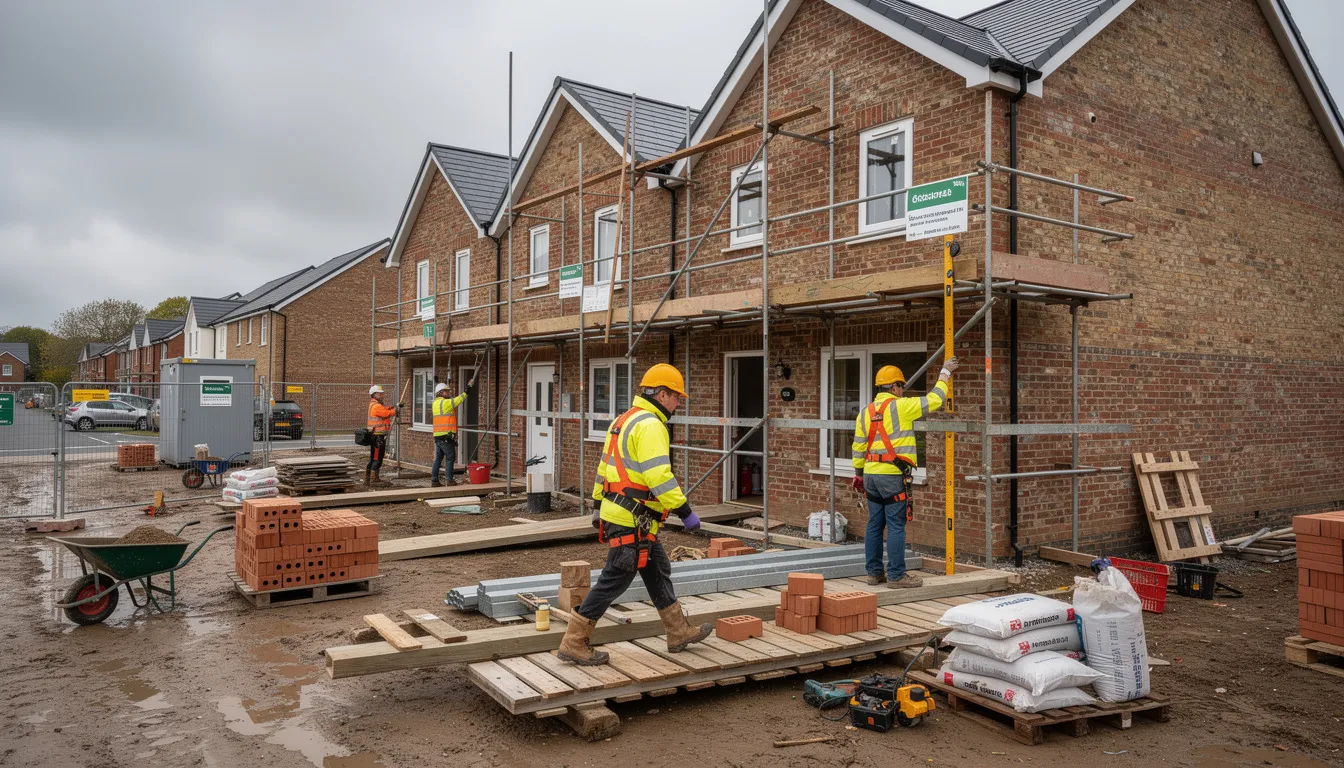
Ground-up finance is used for new-build houses, apartment buildings and mixed-use schemes constructed from vacant or cleared sites. It’s the most comprehensive form of development funding.
Key features include funding for both land acquisition and build costs, with the facility structured as two linked elements. Drawdowns are staged and certified by a monitoring surveyor who inspects progress at each milestone. Interest is typically rolled up or retained, preserving cash flow during construction. LTGDV usually reaches up to around 65-70% depending on sector, location and developer experience.
Example: 10-unit new-build scheme
Element | Amount |
|---|---|
GDV (10 flats at £250k each) | £2,500,000 |
Land purchase | £400,000 |
Build costs | £1,200,000 |
Fees, contingency, interest | £250,000 |
Total project cost | £1,850,000 |
Development loan (65% LTGDV) | £1,625,000 |
Developer equity required | £225,000 |
Lender “must-haves” for ground-up schemes:
- Full planning permission with all pre-commencement conditions discharged
- Fixed-price or detailed build contract with an experienced contractor
- Structural warranty provision (NHBC, LABC, Premier Guarantee or equivalent)
- Quantity surveyor cost report certifying the budget
- Realistic build programme with contingency allowance
Refurbishment and Conversion Finance
Heavy refurbishment and conversion projects sit between ground-up development and simple cosmetic upgrades. The funding approach depends on the scope of works.
Heavy refurbishment involves structural alterations, reconfiguration of layouts, extensions or change of use. Examples include converting a Victorian house into 6 self-contained flats, adding a rear extension to create additional residential units, or transforming redundant offices into modern apartments. These projects are typically funded under development finance terms with staged drawdowns and QS monitoring, as the property’s value changes significantly during works.
Light refurbishment covers kitchens, bathrooms, redecoration and minor upgrades where the fundamental structure remains unchanged. These schemes often suit bridging finance with simpler underwriting, sometimes a single drawdown at completion of purchase, with works funded from the developer’s own resources or a modest retained works facility.
Office-to-residential and retail-to-residential conversions under permitted development rights remain popular in 2026. Lender appetite is generally strong for these schemes in areas with proven residential demand, though valuers scrutinise floor areas, natural light levels and the quality of proposed finished units carefully.
Scenario examples:
A developer purchasing a former high street bank for £800,000 with planning to create 8 flats (GDV £1.6m) might secure 65% LTGDV (£1.04m) against a total project cost of £1.25m, requiring £210,000 equity.
A lighter scheme, purchasing a dated 4-flat block for £600,000 and spending £80,000 on new kitchens, bathrooms and redecoration (GDV £780,000), might suit a 12-month bridging loan at 70% LTV of purchase price, with works funded from cash.
Bridging Loans and Development Exit Loans
Bridging finance is short-term, flexible funding used for acquisitions, quick completions, planning gain strategies and short refurbishments. It’s faster to arrange than full development finance and suits projects where the scope of works doesn’t justify staged drawdowns.
Our advisers also arrange regulated bridging for homeowners, for example, someone downsizing who needs to purchase before their sale completes, or a homeowner breaking a property chain. This is a separate but related product, regulated by the FCA, which we handle alongside development work.
Development exit loans deserve special mention. These facilities refinance completed or near-completed schemes, replacing the development finance at a lower rate once build risk has been removed. Exit loans allow more time to sell remaining units without the pressure of expensive development finance rates, and can release equity to fund construction on your next project before all sales complete.
A developer might switch from development finance to an exit loan once practical completion is achieved and perhaps 50% of units are sold or reserved. The exit facility, typically priced at 0.65-0.85% monthly provides breathing room to achieve full asking prices rather than accepting discounted offers to clear the original loan.
Typical exit loan uses:
- Refinancing a completed scheme to extend the sales period
- Releasing equity from sold units to recycle into the next site
- Converting from rolled-up interest to a lower-cost facility
- Providing stability while waiting for reserved sales to exchange
Costs, Fees and How Pricing Works in 2026
Beyond the headline interest rate, developers must budget carefully for all costs involved in a development finance deal. Underestimating these can squeeze margins or, worse, leave you short of funds late in the project.
- Lender arrangement fee: Typically 1-2% of the total facility, sometimes added to the loan. On a £2m facility, expect £20,000-£40,000.
- Exit fee: Some products charge 1% of the facility or 1% of GDV on redemption. Not universal, but increasingly common on higher-leverage products.
- Broker fee: Fox Davidson may charge up to 1% of the loan for advising and arranging your finance solution. All fees are disclosed clearly before you commit.
- Valuation and monitoring surveyor fees: Initial valuation might cost £2,000-£5,000 depending on scheme size. Monitoring surveyor fees for inspecting drawdown stages typically run £500-£1,000 per visit, with 5-8 visits on a typical scheme.
- Legal fees: Both the lender’s solicitor and your own solicitor charge fees. Budget £5,000-£15,000 combined for a straightforward scheme, more for complex projects.
- Admin and drawdown fees: Small charges (£50-£250) apply for each drawdown request and telegraphic transfer.
- Non-finance costs: CIL, Section 106 contributions, warranty fees and building control costs sit outside the loan but must be funded. These can add 5-10% to total project cost on some schemes.
Interest calculation deserves attention. Rolled-up interest compounds monthly, meaning you pay interest on interest over the loan term. A £2m facility at 0.90% monthly doesn’t cost £216,000 over 18 months in practice staged drawdowns reduce the average balance, but compounding on drawn amounts increases the effective cost. Building a detailed financial model with realistic draw timing is essential.
Example Cost Table (for WordPress)
The following table illustrates typical development finance costs on a mid-sized residential scheme. Figures are for example purposes only and do not constitute an offer.
Item | Amount (£) | Notes |
|---|---|---|
Development loan facility | 2,000,000 | 65% LTGDV on £3.1m GDV scheme |
Arrangement fee (1.5%) | 30,000 | Added to loan or payable on completion |
Broker fee (up to 1%) | 20,000 | Fox Davidson advice and arrangement fee |
Valuation | 3,500 | RICS Red Book valuation |
Monitoring surveyor (6 visits) | 4,500 | £750 per inspection |
Legal costs (combined) | 12,000 | Lender and borrower solicitors |
Estimated rolled-up interest | 145,000 | Based on 15-month average drawdown profile at 0.85% monthly |
Total finance cost | 215,000 | Approximately 10.75% of facility / 6.9% of project cost |
Figures are illustrative only. Actual costs depend on scheme specifics, lender selection and market conditions at the time of application.
How to Apply for Property Development Finance
Thorough preparation accelerates approval and can improve the terms you’re offered. Here’s the typical loan application process when working with Fox Davidson.
Step-by-Step Application Process
- Initial Consultation:
We discuss your project details, experience, equity position and objectives. This can often be done in a single call, with follow-up by email. - High-Level Feasibility Checks:
We assess whether the scheme meets lender thresholds for LTGDV, LTC and profit, and identify the most suitable lenders for your project’s profile. - Term Sheet:
We obtain indicative terms from one or more lenders, setting out proposed rates, fees, conditions and key requirements. - Full Application:
You provide detailed supporting documents (see below), and we submit a comprehensive funding proposal to the chosen lender or lenders. - Valuation and QS Reports:
The lender instructs an independent valuation and, for larger schemes, a quantity surveyor report to verify costs and GDV. - Credit Approval and Offer:
The lender’s credit committee reviews the application and issues a formal offer, typically valid for 3-6 months. - Legal Due Diligence:
Solicitors for both parties work through title, planning, loan agreement terms and security documentation. - Completion and Drawdown:
Initial funds are released on completion. Subsequent drawdowns follow as construction progresses and the monitoring surveyor certifies each stage.
Before approaching lenders, ensure you have ready: a detailed schedule of works and build cost breakdown, your professional CV plus details of contractor and professional team, planning consent and approved drawings, a cashflow forecast showing timing of costs and drawdowns, and a clear exit strategy.
Fox Davidson package and present your case to multiple lenders simultaneously, negotiating on your behalf to secure a competitive deal while saving you significant time.
What Documents Will You Need?
Preparing comprehensive documentation upfront prevents delays. Here’s what lenders typically require:
- Planning permission decision notice and approved plans: Full consent with any relevant conditions listed
- Detailed costings: Preferably a QS report, or at minimum a contractor’s priced schedule of works
- Build programme: A Gantt chart or timeline showing key milestones and completion date
- Development appraisal: Spreadsheet showing GDV, all costs, profit margin and sensitivity analysis
- Personal and company accounts: Last 2-3 years where available; management accounts for newer companies
- Asset and liability statement: Your net worth, property portfolio and outstanding borrowings
- Proof of funds for equity: Bank statements or facility letters showing available cash
- Professional CVs: For yourself, your contractor and key consultants
- Tenancy schedules: For any income-producing elements during the works (eg: retained commercial tenants)
In the 2026 cost environment, lenders scrutinise build costs particularly closely. Out-of-date quotes or unrealistic allowances will be challenged. Ensure your information is current and reflects today’s market pricing.
Exit Strategies and Refinancing
Every lender requires a credible exit strategy at the outset. Your planned exit is central to the underwriting decision, if the lender can’t see how they’ll be repaid, they won’t lend.
The main options are sale of all units on the open market (the most common exit), retain and refinance onto longer-term products, or a blend combining partial sales with refinance of retained units.
For developers planning to hold completed units, refinance options include buy-to-let mortgages for single lets within a limited company structure, specialist HMO and MUFB mortgages for multi-occupancy properties, and commercial mortgages for trading or investment commercial buildings.
Fox Davidson also arrange these exit products, helping you plan the transition from development finance to long-term finance before you even complete your build. This joined-up approach ensures your exit is achievable from day one.
We also secure development exit finance to allow more time to finish a build and sale units.
Exit planning tips:
- Research comparable sales evidence before finalising your GDV assumptions
- Obtain refinance quotes at the appraisal stage to confirm viability
- Factor in estate agency fees (typically 1-1.5% plus VAT) and legal costs on sales
- Build in a realistic sales period—3-6 months minimum for most residential schemes
- Consider pre-sales or reservations to de-risk the exit, especially on larger projects
In 2026, lenders scrutinise projected sale rates, achievable rents and stress-tested refinance criteria closely. Higher interest rates compared with pre-2022 mean rental coverage tests are tighter, so early planning on the exit is more important than ever.
Specialist Sectors and Case-Study Style Examples
Real-world scenarios illustrate how development finance works in practice. The following are typical of the projects Fox Davidson arrange, with details anonymised.
Case Study 1: Office-to-Residential Conversion, South West England (2025)
A developer acquired a vacant office building in a Bristol suburb for £1.2m, with planning consent to create 20 self-contained flats. The GDV was assessed at £4m based on comparable sales of £180,000-£220,000 per unit.
Fox Davidson arranged a £2.68m development facility (67% LTGDV) with a specialist lender at 0.88% monthly. The loan covered 75% of the purchase price plus 100% of build costs, with the developer contributing £320,000 equity. The 18-month term allowed 12 months for construction and 6 months for sales.
The project completed on schedule despite supply chain delays on windows, with 14 units sold before practical completion. The developer exited within 16 months, achieving a profit on cost of 24%.
Case Study 2: HMO Development, Birmingham (2024-2025)
A limited company purchased a large Victorian property in Selly Oak for £380,000, with planning to convert it into a 9-bedroom licensed HMO targeting students at the nearby university.
Development finance of £520,000 covered the purchase and £220,000 of works, representing 68% of the £765,000 GDV. The developer contributed £140,000 equity. On completion, Fox Davidson arranged refinance onto a specialist HMO mortgage at 5.8% fixed for 5 years, releasing all the developer’s original equity to fund their next project.
Case Study 3: Mixed-Use Scheme, London Commuter Town (2025-2026)
A mixed-use development in Surrey combined a ground-floor café unit with 8 flats above, on the site of a former pub. The GDV was £3.2m, with total costs of £2.4m including £600,000 for the site.
The commercial element required careful structuring, pure retail would have attracted lower leverage, but a signed heads of terms with a café operator satisfied lender requirements. Fox Davidson secured £2.08m (65% LTGDV) from a specialist development lender comfortable with mixed-use projects, at 0.95% monthly.
The scheme completed in 14 months, with all residential units sold off-plan and the commercial unit let on a 10-year lease.

HMOs, MUFBs and Student Accommodation
Many UK property developers in 2026 target HMOs, multi-unit freehold blocks and purpose-built student accommodation. Ongoing demand in university cities and employment hubs makes these sectors attractive for experienced developers.
Lender appetite varies by sub-sector. HMO conversions attract good interest where the property will be professionally managed, fully licensed and in a strong rental location. New-build HMOs are less common but fundable with the right operator. Splitting large houses into multiple self-contained flats (creating a MUFB) is popular and generally well-received by lenders, particularly where Article 4 directions don’t apply.
Student schemes require strong demand evidence, typically a university within walking distance or on a direct bus route, plus data on student numbers and existing supply. Purpose-built student accommodation attracts specialist lenders who understand the sector’s specific risk profile.
Development finance can cover the conversion or construction works, with planned exit via specialist HMO or MUFB mortgages in a limited company structure, or sale to other private investors. Fox Davidson arrange both the development finance and the exit product, ensuring a smooth transition.
Licensing, planning and building regulations compliance are scrutinised carefully. Lenders want to see that mandatory licensing requirements are understood, fire safety measures are incorporated, and the scheme complies with local planning policies on HMO concentrations.
Commercial and Semi-Commercial Development
Purely commercial development, warehouses, offices, retail parks, face more cautious lending in 2026. Lenders want to see strong pre-lets, anchor tenants, or evidence of robust occupier demand before committing.
Semi-commercial assets, such as a shop with flats above or a mixed-use block with offices and apartments, often attract better terms. The residential element provides diversification and, typically, a clearer exit route.
For commercial schemes intended for owner-occupation, lenders look for a credible business plan showing how the building will support the trading business. For investment properties, pre-let agreements demonstrating future rental income are essential.
If your plan is to hold the commercial asset long-term, you’ll need to demonstrate that refinance onto a commercial mortgage is achievable. This means showing the projected rental income covers debt service with headroom typically 125-150% coverage at stressed interest rates.
Fox Davidson specialise in commercial mortgages as well as development finance. We help developers align their short-term development or bridging finance with the long-term funding needed to hold completed commercial buildings.
Typical examples include logistics units near motorway junctions (strong demand in 2026), high street conversions with retail retained at ground floor, and light industrial schemes for owner-occupiers or investors.
Property Development Finance FAQ’s (2026)
Frequently Asked Questions
These frequently asked questions address common queries from UK developers and investors. Answers reflect current market conditions and lender criteria.
What is property development finance in the UK?
Property development finance is short-term funding for land acquisition and construction or refurbishment costs, typically running 6-24 months. It’s repaid from the sale or refinance of the completed scheme. Unlike traditional loans assessed on income, development finance focuses on the project’s gross development value and viability. Fox Davidson arrange facilities from £250,000 to £100m+ across England, Wales, Scotland and Northern Ireland.
How much deposit do I need for development finance?
Most lenders require developer equity of 25-35% of total project cost. This can comprise cash, land value (if purchased at arm’s length) or a combination. For a project costing £1m, expect to contribute £250,000-£350,000. Mezzanine finance can reduce your cash requirement but at higher overall cost.
Can I get development finance as a first-time developer?
Yes, though terms are typically more conservative. First-time developers should appoint an experienced main contractor, engage professional project managers, and build a strong team. Some lenders specifically support newcomers; others require joint venture arrangements with experienced partners. Fox Davidson can advise on structuring your application to maximise approval chances.
What are current UK development finance interest rates in 2026?
Indicative rates for well-structured residential schemes range from approximately 0.80% to 1.10% per month (roughly 9.6%-13.2% p.a.). Rates depend on leverage, developer experience, location and loan size. Ground-up schemes typically cost more than light refurbishments. A personalised quote is essential as pricing varies significantly between lenders.
Can I use development finance to build my own home?
If you intend to live in the completed property, the loan becomes regulated under FCA rules. Fox Davidson can arrange regulated bridging or self-build mortgages for these projects. The application process differs from commercial development finance, with additional protections for borrowers.
How is development finance different from a bridging loan?
Bridging loans are short-term facilities typically used for acquisitions, chain-breaking or light refurbishments, usually with a single drawdown. Development finance includes staged drawdowns certified by a monitoring surveyor, making it suitable for more complex construction projects. Some schemes sit between the two, Fox Davidson advise on the most appropriate structure.
How do lenders calculate Gross Development Value (GDV)?
GDV is assessed by an independent RICS valuer based on comparable evidence—recent sales of similar properties in the area, adjusted for specification, location and market conditions. The valuer provides a “special assumption” valuation, estimating what the completed development will be worth. Lenders typically cap loans at 65-70% of this figure.
Can I get 100% development finance?
there are a couple of lenders who will lend 100% to experienced property developers building similar schemes. Otherwise, it’s possible to structure close to 100% funding using layered finance. Senior debt at 65% LTGDV combined with mezzanine at 20% and JV equity for the remainder can minimise your cash input. However, the overall cost rises significantly, and lenders still want to see developer commitment,, usually at least some personal funds at risk.
What happens if my project overruns?
Build overruns are common, RICS data suggests 20% of UK projects exceed their original timeline. Most facilities include a contingency period (3-6 months) beyond the planned build. If you need longer, extension options are usually available at additional cost. Communicate early with your lender if delays are likely; Fox Davidson can help negotiate extensions or refinance solutions.
Do I need planning permission before applying for development finance?
Full planning consent is typically required before drawdown, though some lenders issue terms on outline consent or planning applications. Having consent in place strengthens your application significantly, as it removes a major risk factor. Pre-planning advice is available if you’re at earlier stages, securing consent first usually results in better finance terms.
Working with Fox Davidson on Your Next Development
Fox Davidson are award-winning UK mortgage brokers with deep expertise in property development finance. We arrange facilities from £250,000 to over £100m for developers across England, Wales, Scotland and Northern Ireland, working on residential, mixed-use and commercial property schemes of all sizes.
Using a specialist broker offers significant advantages. You gain access to a wide panel of development lenders, from high-street banks to private funds, rather than being limited to whoever you approach directly. We provide tailored structuring for complex and large schemes, drawing on experience across ground-up builds, heavy refurbishments, conversions and mixed-use projects. And we guide you through exits into commercial mortgages, buy-to-let products and bridging finance, ensuring continuity from acquisition through to long-term hold.
Fox Davidson may charge up to 1% of the loan amount for advising and arranging development finance. All fees are disclosed clearly before you commit to any application, with no surprises at completion.
Whether you’re planning your first ground-up scheme or scaling an established portfolio, early engagement at the feasibility stage helps shape your project for success. We can model numbers, identify potential lender concerns, and advise on structuring before you’re committed to a site—often saving significant time and money.
Contact Fox Davidson to discuss your development finance requirements. Initial conversations are without obligation, and we’re happy to review your figures and plans at any stage of the development process.
📞 Call for immediate expert advice. 💻 Complete our enquiry form 📧 Email outline your requirements